
 English
 简体中文
简体中文 Русский
 Español
 Deutsch
Why Kayak Paddle Length Matters More Than You Think
Ask any experienced paddler what the single most overlooked piece of kayak gear is, and many will say the paddle. You can spend hours obsessing over hull design, seat comfort, and dry bags, but if your paddle is the wrong length, every stroke becomes harder than it needs to be. A paddle that is too short forces you to lean forward and over-reach, straining your shoulders and lower back. A paddle that is too long makes each stroke feel sluggish and inefficient, wasting energy you could be using to cover distance.
This guide breaks down the kayak paddle length chart by height, explains the variables that change the recommendation, and gives you a practical method for choosing the right size the first time. Whether you are a beginner buying your first recreational kayak or an intermediate paddler upgrading to a touring or whitewater setup, the principles here will help you paddle farther with less fatigue.
The Basic Kayak Paddle Length Chart by Height
The most common starting point for paddle sizing is your height. The chart below is a general reference for recreational and touring kayaks with standard-width hulls. Use it as a baseline, then adjust for your kayak width and paddling style.
| Paddler Height | Recreational / Touring Paddle Length | Whitewater Paddle Length |
|---|---|---|
| Under 5'0" (152 cm) | 200–210 cm | 188–194 cm |
| 5'0"–5'4" (152–163 cm) | 210–220 cm | 190–196 cm |
| 5'4"–5'8" (163–173 cm) | 215–220 cm | 192–198 cm |
| 5'8"–6'0" (173–183 cm) | 220–230 cm | 194–200 cm |
| 6'0"–6'4" (183–193 cm) | 225–235 cm | 196–202 cm |
| Over 6'4" (193 cm) | 230–240 cm | 198–204 cm |
Notice the overlap between height brackets. That overlap exists because height alone does not determine paddle length. Two paddlers of the same height can need paddles five centimeters apart if one paddles a wide sit-on-top and the other paddles a narrow sea kayak.
Why Height Alone Is Not Enough
Height is a convenient proxy for torso length and arm span, but it is imperfect. A paddler with a long torso and short arms may need a shorter paddle than the chart suggests, while someone with a long wingspan and a short torso may need a longer one. If you have ever wondered why a friend of the same height prefers a different paddle, this is why.
Instead of measuring height alone, measure your torso and arm reach. Sit on the floor with your back straight, then measure from the floor to the top of your shoulder. Paddlers with a torso longer than average should lean toward the upper end of their height bracket, and those with a shorter torso should lean toward the lower end.
Kayak Width: The Hidden Variable
Kayak width, often called beam, has a direct effect on paddle length. A wider kayak requires a longer paddle because your hands must travel farther to reach the water on each side. The general rule is simple: add length for width.
- Narrow kayaks (under 24 inches / 61 cm): subtract 5 cm from the chart recommendation.
- Standard kayaks (24–28 inches / 61–71 cm): use the chart recommendation as-is.
- Wide kayaks (28–32 inches / 71–81 cm): add 5 cm.
- Very wide kayaks (over 32 inches / 81 cm): add 10 cm or more.
Sit-on-top fishing kayaks are frequently 32 to 36 inches wide, which is why anglers often paddle with 240 to 260 cm paddles. A recreational paddler in a 26-inch kayak using a 240 cm paddle would feel like they are stirring soup.
Paddling Style Changes the Ideal Length
How you paddle matters as much as where you paddle. Different disciplines have different length conventions.
Recreational and Touring
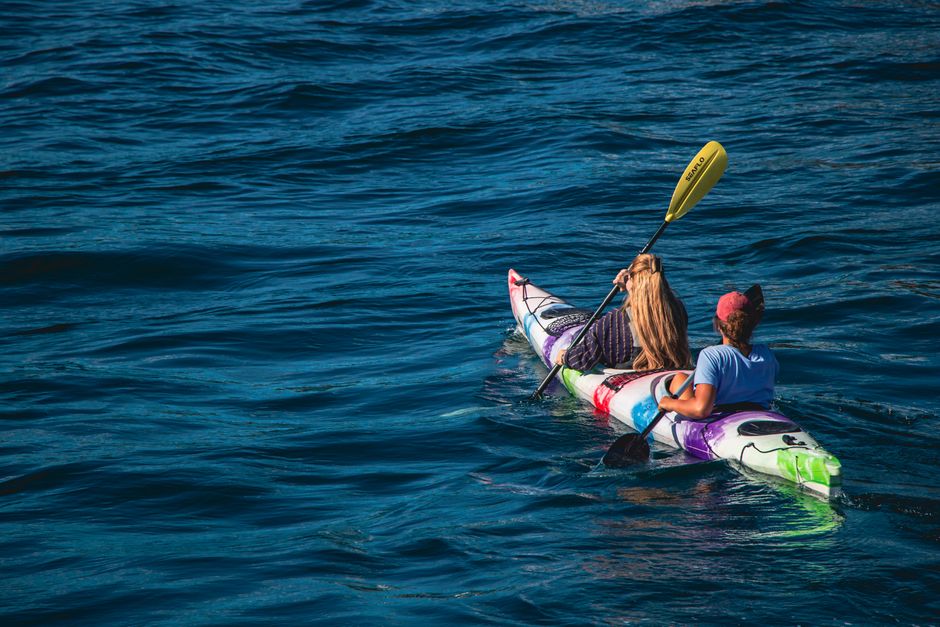
Recreational paddlers favor 220 to 240 cm for relaxed cruising and easy turning. Touring paddlers often choose 210 to 220 cm for a more vertical, efficient stroke that tracks better over long distances. If you plan to cover 10 or more miles in a day, a shorter paddle with a higher stroke cadence will usually serve you better.
Whitewater
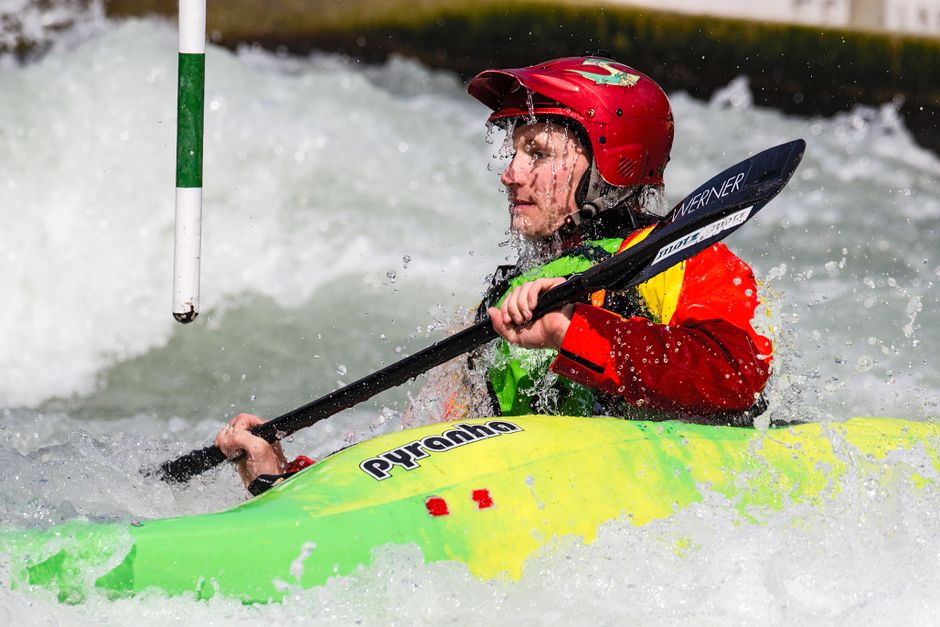
Whitewater paddles are much shorter, typically 188 to 204 cm. The short length lets you make quick, powerful strokes and brace effectively in moving water. A long touring paddle in a whitewater boat feels unwieldy and slow to react.
Surf and Surf Ski
Surf kayakers and surf ski paddlers use short paddles, often 200 to 215 cm, to generate rapid acceleration and control. Surf skis are narrow, so the short length still reaches the water comfortably.
Racing and Fitness
Racing paddles are the shortest of all, sometimes 200 cm or less, paired with a wing blade. The goal is a high stroke rate and a compact, powerful motion. This style is not recommended for beginners because it demands good technique and core strength.
Blade Shape and Its Effect on Length
Blade design influences the length you should choose. High-angle blades are shorter and wider, designed for a vertical stroke close to the boat. Low-angle blades are longer and narrower, designed for a flatter, more horizontal stroke. The two styles call for different paddle lengths.
- High-angle paddlers: choose a paddle 5 to 10 cm shorter than the chart suggests.
- Low-angle paddlers: choose a paddle at or slightly above the chart recommendation.
If you are unsure which style you use, watch a video of yourself paddling. If your top hand passes above your shoulder and the blade enters the water near your hip, you are a high-angle paddler. If your stroke is flatter and the blade enters farther forward, you are low-angle.
How to Measure Paddle Length at Home
You can size a paddle without a chart using a simple body measurement. Stand a paddle upright with the tip on the floor and the blade facing you. The top of the paddle should reach somewhere between your chin and your nose for a recreational paddle, or between your nose and the top of your head for a touring paddle.
Another method is the arm-span test. Hold the paddle horizontally across your chest with your hands at shoulder width. The distance between your hands should be roughly the distance from the floor to your nose when standing. This is the shaft length you need, and blade length is added on top.
These tests are approximations. The most reliable approach is to borrow or rent paddles in two or three lengths and paddle each for at least 20 minutes. Your shoulders and wrists will tell you quickly which one feels natural.
Common Mistakes to Avoid
- Buying a paddle that is too long because it feels powerful in the store. A long paddle feels strong for the first few strokes and tiring after an hour.
- Ignoring kayak width. A paddle that works in a narrow kayak will feel too short in a wide one.
- Assuming all paddles of the same length are equal. Blade size, shaft material, and feathering all affect how a paddle performs.
- Never adjusting after purchase. Many paddles have adjustable ferrules that let you change length and blade offset, so experiment on the water.
Adjustable Paddles: A Practical Compromise
If you are new to kayaking or paddle multiple boats, an adjustable two-piece or three-piece paddle is an excellent choice. Adjustable paddles typically span 210 to 240 cm and let you fine-tune length as you learn. They are also easier to store and transport. The trade-off is a slight weight penalty and a small amount of flex at the connection point, but for recreational paddlers the convenience usually outweighs the drawbacks.
Once you know your preferred length, you can invest in a fixed-length paddle for maximum stiffness and efficiency.
Quick Reference Summary
To choose a kayak paddle length, start with your height on the chart, then adjust for kayak width, paddling style, and blade angle. Add 5 to 10 cm for wide kayaks, subtract 5 to 10 cm for high-angle or racing styles, and lean toward the shorter end if you value efficiency over leverage. When in doubt, test before you buy, and remember that a paddle is one of the few pieces of kayak gear you will touch on every single stroke. Getting the length right is the cheapest performance upgrade available.
Ask us anything about construction, materials, samples or shipping — we answer personally.