
Introduction
Choosing the right air compressor for your business is critical for efficiency, cost savings, and productivity. Two of the most common types are screw (rotary) and piston (reciprocating) compressors. This article compares their features, advantages, and limitations to help you make an informed decision.
How They Work
Piston Compressors
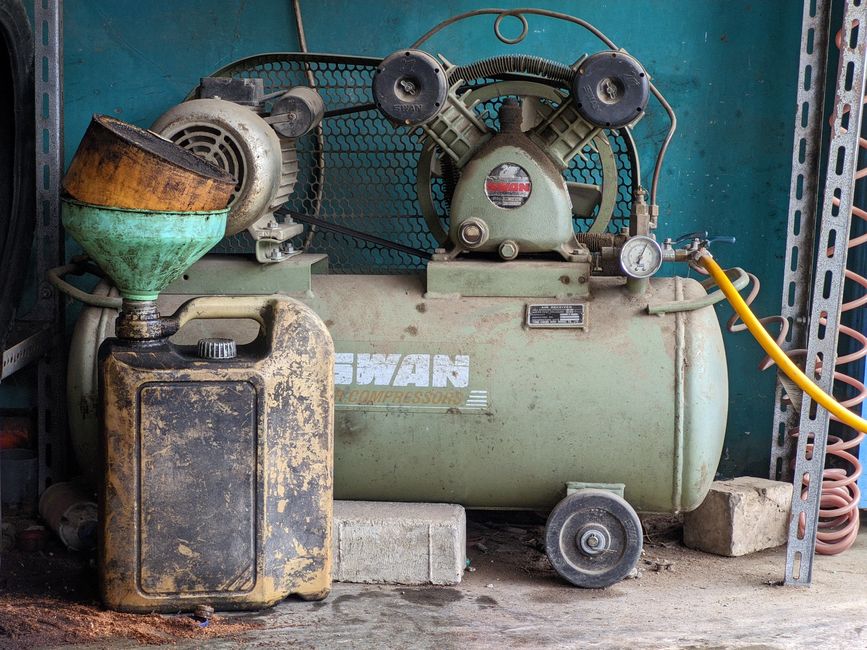
Piston compressors use a reciprocating piston within a cylinder to compress air. They operate in cycles, drawing air in and then compressing it with a downward stroke. They are typically available in single-stage or two-stage configurations.
Screw Compressors
Screw compressors use two interlocking helical rotors to continuously compress air. As the rotors turn, air is trapped between them and progressively compressed. This design provides a continuous, pulsation-free air flow.
Key Comparison Table
| Feature | Piston Compressor | Screw Compressor |
|---|---|---|
| Operation | Intermittent (on/off cycles) | Continuous (modulation or load/unload) |
| Air Quality | Higher oil carryover, more pulsation | Lower oil carryover, smooth flow |
| Duty Cycle | Typically 50-70% | Up to 100% |
| Maintenance | Frequent (valves, rings, belts) | Less frequent (oil/filter changes) |
| Lifespan | 10-15 years | 15-20+ years |
| Initial Cost | Lower | Higher |
| Energy Efficiency | Lower at full load | Higher, especially at partial load |
| Noise Level | Louder (typically 80-90 dB) | Quieter (typically 70-75 dB) |
| Footprint | Smaller (vertical or horizontal) | Larger (enclosed units) |
| Best For | Intermittent use, small workshops | Continuous use, industrial applications |
Detailed Analysis
Duty Cycle and Usage
Piston compressors are designed for intermittent use. They require a cool-down period after running, typically limited to a 50-70% duty cycle. In contrast, screw compressors can run 100% of the time, making them ideal for 24/7 operations.
Air Quality
Screw compressors generally produce cleaner air with less oil carryover due to efficient separation systems. Piston compressors tend to introduce more oil and moisture, which may require additional filtration for sensitive applications.
Maintenance
Piston compressors have many moving parts (valves, piston rings, gaskets) that wear out faster and require regular replacement. Screw compressors have fewer wear parts, with main maintenance being oil and filter changes every 1000-2000 hours.
Energy Efficiency
At full load, screw compressors are typically more efficient. They also perform better at partial loads due to modulation controls. Piston compressors are less efficient because of higher friction and intermittent operation.
Noise
Screw compressors are generally quieter due to their continuous rotary motion and sound-dampening enclosures. Piston compressors produce significant vibration and noise from reciprocating parts.
When to Choose Piston
- Low initial budget
- Intermittent use (e.g., home garage, small repair shop)
- Lower air flow requirements (up to 30 CFM)
- Space constraints
When to Choose Screw
- Continuous or heavy-duty use
- High air flow demands (above 30 CFM)
- Need for energy efficiency and lower operating costs
- Quiet operation required
- Long-term investment with lower maintenance
Recommendation
For most B2B manufacturing environments where compressed air is a critical utility, a screw compressor is the superior choice. The higher initial cost is offset by lower energy bills, reduced maintenance, longer lifespan, and reliable continuous operation. However, if your application is light-duty and intermittent, a piston compressor can be a cost-effective solution. Evaluate your duty cycle, air quality needs, and budget before deciding.
Conclusion
Both screw and piston compressors have their place in the market. By understanding their differences, you can select the compressor that maximizes your productivity and minimizes your total cost of ownership. If you need further assistance, contact our experts for a personalized recommendation.