
Introduction
When selecting an air compressor for your manufacturing operations, efficiency is a critical factor that directly impacts your energy costs and productivity. This guide compares the efficiency of various air compressor types to help you make an informed decision.
Types of Air Compressors
We'll evaluate three common types used in B2B settings: reciprocating (piston), rotary screw, and centrifugal compressors.
Reciprocating Compressors
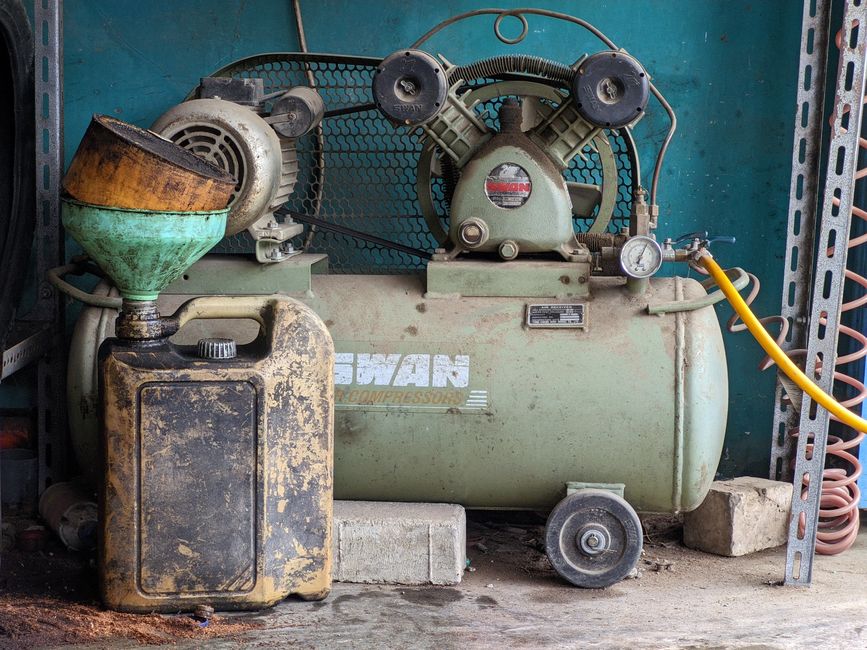
These positive displacement units use pistons driven by a crankshaft. They are suitable for intermittent use and lower flow rates.
Rotary Screw Compressors
These use two interlocking helical rotors to compress air continuously. They are ideal for continuous operation and medium to high flow rates.
Centrifugal Compressors
These dynamic compressors use a rotating impeller to accelerate air, then decelerate it in a diffuser for pressure rise. Best for very high flow rates in large industrial settings.
Efficiency Comparison Table
| Compressor Type | Specific Power (kW/100 cfm) | Part-Load Efficiency | Maintenance Cost | Typical Application |
|---|---|---|---|---|
| Reciprocating | 20-25 | Poor | High | Intermittent, low flow |
| Rotary Screw | 16-22 | Good (with VSD) | Moderate | Continuous, medium flow |
| Centrifugal | 15-20 | Excellent (with inlet guide vanes) | Low | Continuous, high flow |
Key Efficiency Metrics
- Specific Power: Power consumed per unit of air flow (kW/100 cfm). Lower is better.
- Part-Load Efficiency: Performance when demand is less than full capacity. Variable speed drives (VSD) improve this.
- Total Cost of Ownership (TCO): Includes purchase, installation, energy, and maintenance over lifespan.
Factors Affecting Efficiency
Compressor Size and Load Profile
Oversized compressors waste energy. Match capacity to demand. For fluctuating loads, consider multiple units or VSD.
Inlet Air Conditions
Cooler, cleaner inlet air improves efficiency. Ensure proper filtration and ventilation.
Maintenance
Regular filter changes, oil checks, and system inspections prevent efficiency loss.
Recommendation
For most B2B manufacturers with continuous operation, a rotary screw compressor with VSD offers the best balance of efficiency, reliability, and cost. For very high flow rates, centrifugal compressors excel. Reciprocating compressors are best for low-duty cycles. Always consider your specific demand profile and consult with experts.
Conclusion
Efficiency is not just about purchase price—it's about long-term savings. Use the comparison table and factors above to choose the right air compressor for your business. Contact us for a personalized assessment.