

Lift Table vs Scissor Lift: Which to Choose?
If you are equipping a warehouse, production floor, loading dock, or retail backroom, you have probably run into two terms that sound almost interchangeable: lift table and scissor lift. They are not the same machine, and choosing the wrong one can cost you money, floor space, and operator safety. This guide breaks down how each device works, where each excels, and how to match the right equipment to your application.
The Core Difference in One Paragraph
A lift table is a fixed-position device, usually bolted to the floor, that raises and lowers a platform to bring work to a comfortable height. A scissor lift is a mobile aerial work platform that raises workers and tools so they can reach overhead tasks. The mechanism looks similar (both use crossed, scissor-like legs), but the purpose, capacity, safety standard, and cost are completely different.
How a Lift Table Works
Lift tables use a scissor mechanism driven by hydraulic cylinders. They are installed at a fixed location and typically travel only a short vertical distance, often between 12 and 60 inches. Common configurations include:
- Stationary lift tables — bolted down for ergonomic work positioning or machine feeding.
- Low-profile lift tables — as low as 3 inches collapsed, ideal for pallet handling.
- Rotating and tilting tables — add powered rotation or tilt for assembly and painting.
- Mobile lift tables — fitted with casters for occasional repositioning at low heights.
Lift tables are governed by standards such as ANSI/ASME B20.1 and are rated for loads from a few hundred pounds to over 10,000 pounds. They are classified as material handling equipment, not personnel lifts.
How a Scissor Lift Works
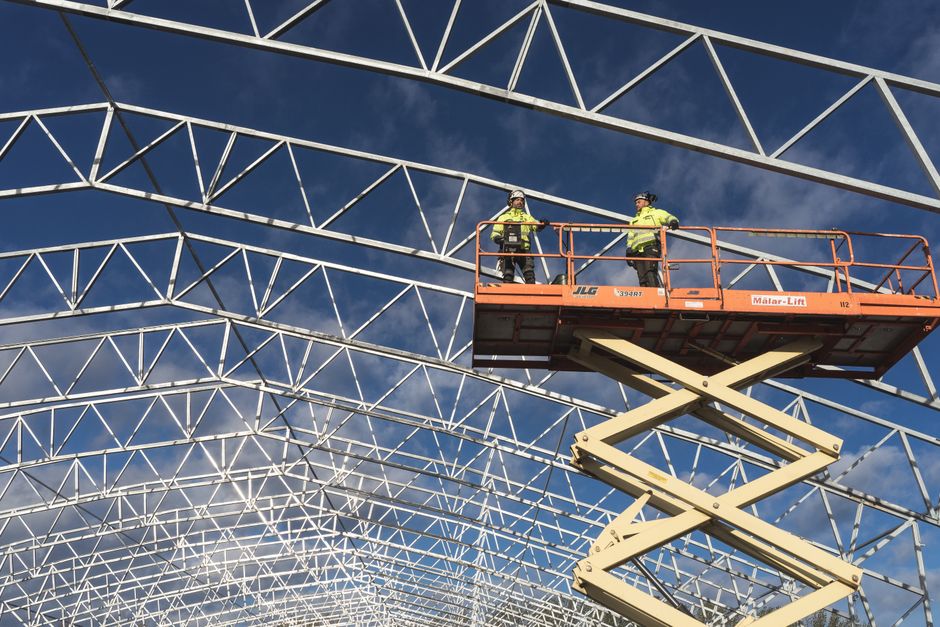
A scissor lift is a self-propelled or push-around aerial work platform. The operator stands on the platform and raises it to work at height, typically 10 to 40 feet. Key features include:
- Slab scissor lifts — electric, for indoor use on flat concrete.
- Rough-terrain scissor lifts — diesel or dual-fuel, for outdoor construction sites.
- Drivable at height — many models allow movement with the platform raised.
- Guardrails, toe boards, and fall protection — required because they carry people.
Scissor lifts are governed by ANSI A92.6 and OSHA 1926.453. They are classified as aerial work platforms (AWPs), which means operator training and familiarization are mandatory.
Side-by-Side Comparison
| Feature | Lift Table | Scissor Lift |
|---|---|---|
| Primary purpose | Position materials at ergonomic height | Elevate workers to reach overhead tasks |
| Mobility | Fixed or caster-mounted, low travel | Self-propelled, drives at height |
| Typical lift height | 12–60 inches | 10–40 feet |
| Load capacity | 500–10,000+ lbs | 500–1,500 lbs (platform + workers) |
| Carries people? | No (material only) | Yes (workers and tools) |
| Governing standard | ANSI/ASME B20.1 | ANSI A92.6 / OSHA 1926.453 |
| Operator training | Basic safety training | Mandatory formal training + familiarization |
| Power source | Electric hydraulic, air, or manual | Electric, diesel, or dual-fuel |
| Typical price range | $1,500–$15,000 | $15,000–$80,000+ |
| Floor space required | Small footprint, fixed location | Large turning radius and travel path |
| Best for | Ergonomics, pallet positioning, feeding machines | Maintenance, installation, overhead work |
When a Lift Table Is the Right Choice
Choose a lift table when the problem you are solving is ergonomic positioning, not height access. Typical winning scenarios:
- Operators bending and reaching all day to build or pack on a fixed surface.
- Feeding a press, conveyor, or packaging machine at a consistent height.
- Transferring pallets between a pallet jack and a work surface.
- Loading and unloading trucks with a dock-level or ground-level table.
- Tight floor space where a mobile aerial platform cannot maneuver.
Lift tables are also dramatically cheaper to buy, install, and maintain, and they do not require the formal operator certification that scissor lifts do.
When a Scissor Lift Is the Right Choice
Choose a scissor lift when the task is overhead work that a ladder or rolling scaffold cannot safely or efficiently handle:
- HVAC, electrical, and sprinkler installation or maintenance.
- Painting, drywall, and ceiling work in large facilities.
- Signage, lighting, and camera installation.
- Stocking high racking in warehouses with wide aisles.
- Exterior construction where rough-terrain capability is needed.
Scissor lifts win on productivity for repeated overhead tasks because the operator can reposition without climbing down. That productivity gain often justifies the higher rental or purchase cost.
Cost and ROI Comparison
A stationary lift table typically costs between $1,500 and $15,000, with minimal installation and maintenance. A scissor lift ranges from $15,000 to $80,000 or more, plus training, inspection, and higher maintenance costs. However, if a scissor lift replaces a ladder for 20 hours of overhead work per week, the labor savings and safety improvement can pay back the investment within a year.
Renting is often the smartest first step: rent a scissor lift for a project, and buy a lift table for a permanent ergonomic station.
Common Mistakes to Avoid
- Using a lift table to raise people. This is dangerous and against every relevant standard.
- Buying a scissor lift for material positioning. You will pay far more than necessary for a job a lift table does better.
- Ignoring floor conditions. Rough-terrain scissor lifts need stable ground; slab lifts need flat concrete.
- Skipping training. OSHA requires scissor lift operator training and familiarization on the specific model.
- Underestimating capacity. Always include the weight of workers, tools, and materials in your calculation.
Final Recommendation
If your goal is to move or position materials at a comfortable working height, buy a lift table. It is cheaper, safer for that application, requires less space, and needs no aerial-platform certification.
If your goal is to put workers in the air to perform overhead tasks, buy or rent a scissor lift. It is the correct, compliant, and productive tool for working at height.
Many facilities ultimately need both: a lift table at each ergonomic workstation and a scissor lift for maintenance and installation projects. Match the machine to the task, verify the load and height requirements, and confirm compliance with the applicable ANSI and OSHA standards before you buy.